When the person who hurt you was the person you trusted most, the injury is different, and so is the healing.
Not all trauma comes from strangers or accidents. Some of the most lasting wounds come from the people we depended on: a partner, a parent, a trusted friend, an institution we believed would protect us. This is betrayal trauma, and it has a particular cruelty to it. The injury and the source of safety are the same person. That paradox is what makes it so hard to recover from alone.
The term was introduced by researcher Jennifer Freyd to describe the harm caused when someone we trust and depend on violates that trust. What makes it distinct from other trauma is the bind it creates: when you depend on the person who hurt you, your mind may actually suppress awareness of the betrayal in order to preserve the relationship. That is part of why people stay, doubt themselves, or struggle to name what happened for a long time.
Why it hits differently
With most trauma, the world feels dangerous afterward. With betrayal trauma, something more disorienting happens: your own judgment feels dangerous. You trusted, and trusting led to harm, so the very faculty you’d use to feel safe again is the one that’s been shaken.
- Self-doubt that runs deep: “How did I not see it? How can I trust myself again?”
- Hypervigilance in relationships: scanning for the next betrayal, struggling to relax into closeness.
- A fractured sense of reality, especially when the betrayal involved deception or gaslighting.
- Symptoms that look like classic trauma: intrusive thoughts, sleep disruption, anxiety, layered over a grief for the relationship you believed you had.
The particular grief of it
Betrayal trauma carries a loss most people underestimate. You’re not only recovering from what was done; you’re grieving a version of the relationship, and sometimes a version of yourself, that turned out not to be real. That grief is legitimate and it deserves room. Rushing past it (“just move on,” “you’re better off”) tends to drive it underground rather than resolve it.
How therapy approaches it
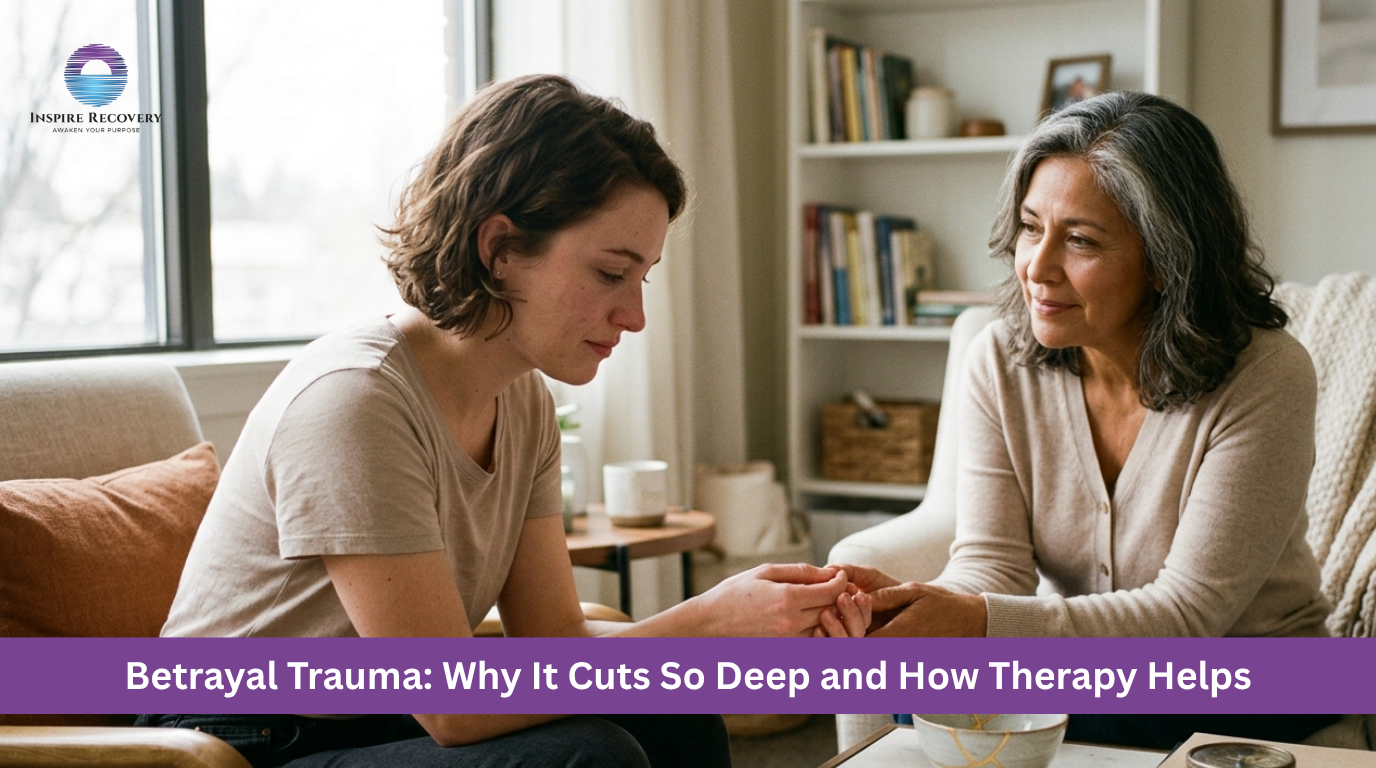
Treatment for betrayal trauma works on a few fronts at once. First, stabilization and validation: having the reality of what happened clearly named and believed, which counters the self-doubt the betrayal installed. From there, processing the trauma itself, often with approaches like EMDR that help the nervous system release what it’s holding. And throughout, the slow rebuilding of trust, first in yourself, eventually, where appropriate, in others.
Rebuilding trust starts not with deciding to trust other people again, but with learning to trust your own perception of reality.

A note for those who feel foolish
Many people carry shame about having been betrayed, as though they should have known. I want to be direct about this: betrayal works precisely because it exploits trust, and trust is not a flaw. The capacity to depend on others is part of being human. Being hurt for it is not a failure of judgment, it’s evidence of someone else’s choice to cause harm.
When the betrayal is by an institution
Betrayal trauma is not limited to personal relationships. People experience it when an institution they trusted, an employer, a faith community, a medical system, a place that was supposed to protect them, fails or harms them and then minimizes it. This form is sometimes overlooked because it doesn’t fit the image of a single betraying person, but the wound mechanism is the same: dependence on something that turned out to be unsafe, and the disorientation of not being believed afterward. The self-doubt it produces can be just as deep.
Naming this matters because people who experience institutional betrayal often don’t feel entitled to call it trauma. They wonder if they’re overreacting. They are usually not. The body keeps a clear record of having trusted and been let down, regardless of whether the source was a person or a system.
The shape of recovery
Recovery from betrayal trauma is rarely linear, and it tends to move through phases that overlap rather than resolve neatly. There is the work of facing what actually happened, the grief for what was lost, the gradual rebuilding of self-trust, and, if you choose it, the careful question of whether and how to trust again. People sometimes expect to feel worse before they feel better, and there is some truth to that: clearly seeing a betrayal you’d been minimizing can be painful. But it is the kind of pain that leads somewhere, unlike the low, grinding ache of carrying it unaddressed.
What we offer is not a script for forgiveness or a timeline for moving on. It is a steady, informed companion through a wound that is genuinely hard to heal alone, because the very capacity you’d use to heal, your trust in your own perception, is what got injured.
If you’re carrying the aftermath of a betrayal that hasn’t healed, you don’t have to sort out whether it “counts as trauma” before reaching out. Bring it as it is. Our team works with this kind of injury, and the first step is simply a conversation about where you are.
Start Your Journey to a Healthier, Happier You
Take the first step today – connect with a compassionate therapist who meets you where you are.
Frequently Asked Questions
Q. Is what I’m feeling actually “trauma,” or am I just making a big deal out of a bad breakup?
If you’re asking this question, you’re probably not overreacting. Betrayal trauma is a real, studied experience, named by researcher Jennifer Freyd, and it shows up in the body the same way other trauma does: racing thoughts, trouble sleeping, that constant low hum of anxiety . So no, you’re not being dramatic. Something in you got hurt, and it makes sense that it doesn’t feel like an ordinary breakup.
Q. Why do I keep blaming myself instead of being angry at them?
Honestly, this is one of the most painful parts, and one of the most common. When you love and depend on someone, part of you fights to protect that relationship, even from the truth. So your mind quietly minimizes what happened, and you end up asking “what’s wrong with me?” instead of “what did they do?” That’s not a character flaw. It’s what happens when trust and harm come from the same place.
Q. Does this only apply to romantic relationships?
Not at all. Betrayal trauma can come from a parent who let you down, a friend who wasn’t who you thought, or even an institution, a job, a church, a doctor’s office, that was supposed to have your back and didn’t. It’s easy to feel like you’re not “allowed” to call that trauma, but if it left you doubting yourself and scanning for the next letdown, it counts.
Q. Will I ever stop feeling like this?
Yes, but probably not on a straight line, and probably not on the schedule anyone tells you to expect. Some days you’ll feel like you’re finally seeing things clearly, and other days you’ll feel worse before you feel better. That’s not you failing at healing, that’s what healing from something this deep actually looks like.
Q. What can therapy give me that I can’t figure out on my own?
Sometimes the most healing thing is simply having someone say, “Yes, that happened, and yes, it was as bad as it felt,” because betrayal often makes you question your own memory of events. From there, therapy (things like EMDR can help) works through the trauma itself. But maybe most importantly, it helps you rebuild trust starting with the person you stopped trusting most: yourself.