When people hear that therapy can treat anxiety as effectively as medication for many conditions, they’re often skeptical. Talking can do that? The honest answer is that Cognitive Behavioral Therapy isn’t really “just talking.” It’s a structured method for changing the specific mental and behavioral patterns that keep anxiety running. Understanding how it works tends to make people far more willing to try it.
The engine of anxiety
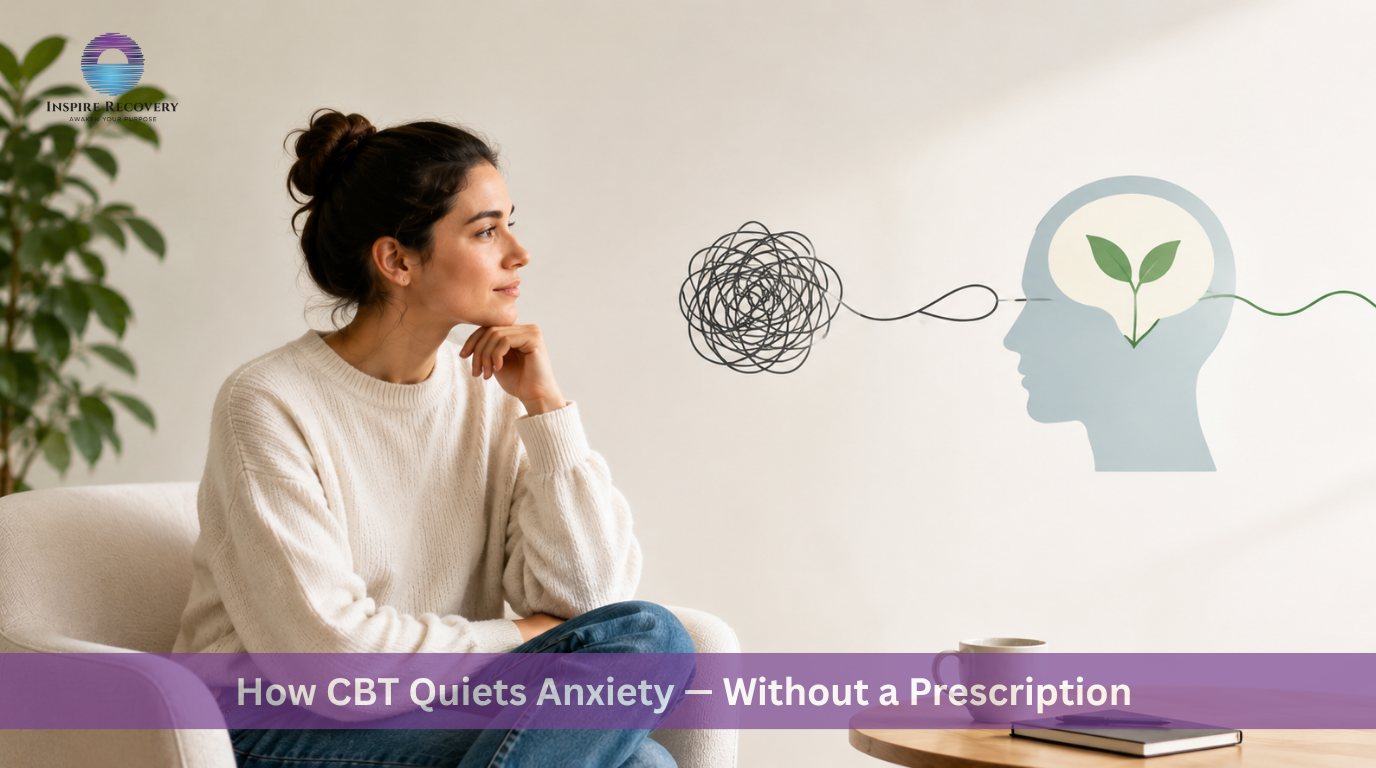
Anxiety runs on a loop. A situation triggers an anxious thought often a prediction of danger or catastrophe. That thought produces physical sensations and emotional distress. To relieve the distress, you avoid the situation or do something to neutralize it. The avoidance brings momentary relief, which teaches your brain that the threat was real and that avoiding it worked. So the loop tightens. The next time, the anxiety is a little stronger.
CBT works by intervening at each point in that loop rather than trying to argue the feeling away.
The cognitive side
Anxious thinking has recognizable distortions overestimating danger, catastrophizing, assuming the worst interpretation. CBT teaches you to catch these thoughts, examine them as predictions rather than facts, and test them against reality. This is not forced positive thinking, which rarely helps. It’s closer to becoming a fair-minded investigator of your own assumptions: “What’s the actual evidence here? What else could be true?”
The behavioral side
This is where CBT earns its results, and where it asks the most of you. Because avoidance is the fuel, recovery requires gradually doing the things anxiety has been telling you to avoid in a planned, manageable progression. Each time you approach something feared and survive it, the nervous system updates its threat assessment. This is more powerful than any reassurance, because it’s lived evidence rather than borrowed comfort.
• You and your therapist build a ladder of feared situations, from mildly uncomfortable to most challenging.
• You work up the ladder at a deliberate pace, staying with each step until the anxiety naturally subsides.
• You learn, in your body and not just your head, that anxiety is uncomfortable but not dangerous, and that it always passes.
Why the results tend to last
Here’s the part that makes CBT especially appealing for people who want to avoid medication: you keep what you learn. Medication works while you take it. CBT changes how you respond to anxiety, and those skills stay with you after treatment ends. Many people find their anxiety not only decreases but becomes something they know how to handle if it returns.
The goal of CBT isn’t a life without anxiety. It’s a life where anxiety no longer makes your decisions for you.

What it asks of you
CBT is active. It involves practice between sessions and a willingness to approach discomfort on purpose, which is precisely what anxiety resists. It’s not the easiest path but it’s one of the most reliably effective, and it doesn’t require a prescription. For people committed to the work, the return is substantial.
A concrete example
It can help to make this concrete. Imagine someone with significant anxiety about social situations. The anxious prediction is that they’ll say something foolish and be judged harshly. To avoid that outcome, they decline invitations, stay quiet in meetings, leave events early. Each avoidance brings relief and confirms the brain’s belief that social situations are dangerous and that escape is necessary. The anxiety, fed by avoidance, grows.
In CBT, this person would examine the prediction how often has catastrophic judgment actually occurred, and what really happens when they speak up? They would then build a graded plan to re-enter social situations deliberately: staying a little longer, contributing one comment, accepting an invitation. Each time the feared catastrophe fails to materialize, the brain updates. Over time, the situations that once triggered dread become ordinary. The change is not that they stopped caring what people think it’s that the fear stopped dictating their behavior.
Why “just relax” never worked
Most anxious people have been told to relax, not to worry, to stop overthinking. They know how useless that advice is, because anxiety doesn’t respond to instruction. CBT works precisely because it doesn’t try to command the feeling away. It changes the inputs the thoughts that generate the alarm and the behaviors that maintain it so the feeling has less to run on. That mechanical clarity is part of why it tends to succeed where willpower and reassurance fail.
If you’d like to treat your anxiety this way, our clinicians at Inspire Recovery use these methods regularly. An assessment is the place to start — it lets us understand your particular anxiety and build a plan that fits how you want to approach it.
Start Your Journey to a Healthier, Happier You
Take the first step today – connect with a compassionate therapist who meets you where you are.
Frequently Asked Questions
Q: Why does avoiding what scares me make my anxiety worse, not better?
It feels backwards, but avoidance is basically anxiety’s fuel source. Every time you dodge something and feel relief, your brain logs it as “that was close, good thing I left.” So next time the urge to avoid is even stronger. It’s a trap that tightens the more you feed it.
Q: Can CBT really work without medication?
For a lot of people, yes. CBT isn’t about willpower or “thinking positive,” it’s a structured way of catching the thoughts that spark anxiety and slowly proving to your own nervous system that the feared thing isn’t as dangerous as it feels. No prescription required.
Q: What does a CBT “ladder” actually look like in practice?
It’s just a list of feared situations ranked from mildly uncomfortable to genuinely tough, and you climb it one rung at a time. You stay on each step until the anxiety settles on its own, then move up. Slow and steady, with no shortcuts.
Q: Will I ever stop feeling anxious after CBT?
Probably not completely, and that’s actually not the goal. CBT isn’t about erasing anxiety forever; it’s about anxiety no longer being the thing that runs your life and makes your decisions for you. Most people still feel it sometimes, they just know what to do with it.
Q: Why doesn’t “just relax” or “stop overthinking” ever help with anxiety?
Because anxiety doesn’t take orders. Telling yourself to relax is trying to argue with a feeling, and feelings don’t really listen to logic. CBT skips that fight entirely, going after the actual thoughts and behaviors feeding the anxiety, so there’s less left for it to run on.