EMDR has a reputation for being slightly mysterious. The eye movements, the talk of “reprocessing,” the dramatic before-and-after stories. If you’re considering it for cognitive strategies , that mystery can be a barrier.
So let me take the mystery out of it and walk through what actually happens, phase by phase. The method follows a structured eight-phase protocol, and knowing the arc tends to make people far more comfortable starting.
Phases one and two: history and preparation
You won’t do any processing in your first sessions, and that’s by design. The work begins with understanding your history and identifying the experiences and beliefs feeding your anxiety.
Then comes preparation, learning grounding and self-soothing skills so you have reliable tools before approaching anything difficult. This stage matters. EMDR done well is never a rush to the hard part.
Phase three: setting the target
Together you identify a specific target: a memory, image, or belief connected to your anxiety. You’ll note the negative belief attached to it (“I’m not safe”), the more adaptive belief you’d like to hold instead (“I can handle this”), and how true each currently feels.
This gives both of you a clear baseline to measure against.
Phases four through six: processing
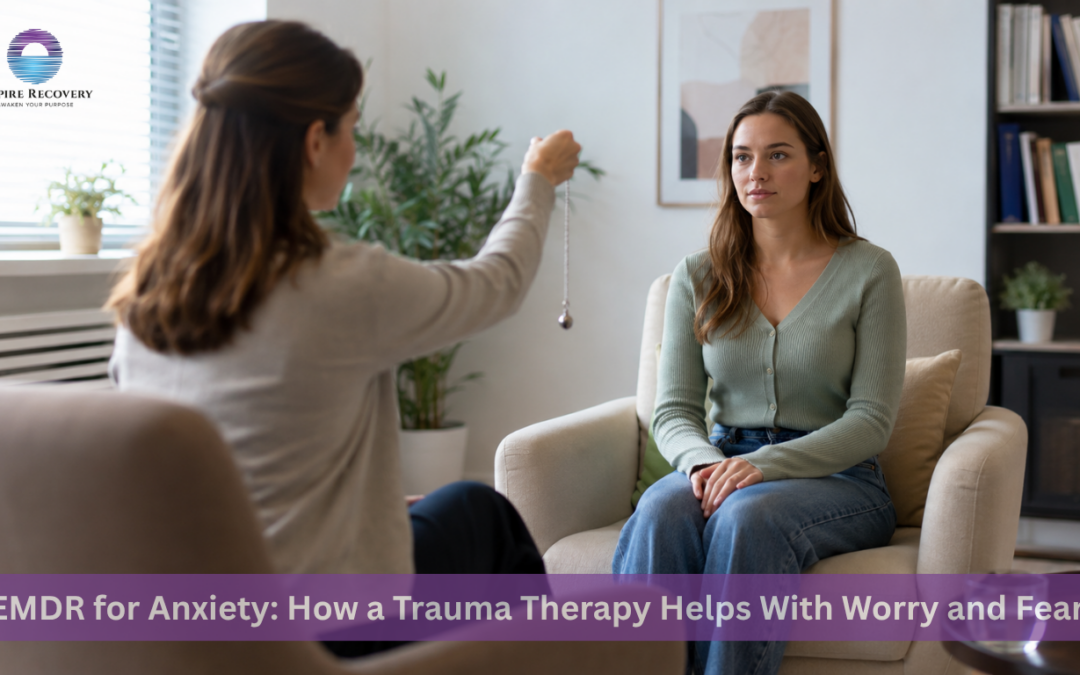
This is the part people picture. You hold the target in mind while following a back-and-forth stimulus, the therapist’s moving hand, a light bar, or alternating taps or tones.
After each short set, you pause and notice whatever came up: thoughts, images, sensations, shifts. You don’t have to perform or explain. You simply notice, and the processing tends to move on its own.
Distress attached to the target gradually decreases across sets, often something you can feel happening in the room. The adaptive belief you chose is strengthened until it feels genuinely true rather than merely logical. A body scan checks for any remaining tension connected to the target, since anxiety lives in the body as much as the mind.
Phases seven and eight: closing and review
Every session is closed deliberately, returning you to a settled state before you leave. You won’t be sent out mid-process.
At the start of the next session, you and your therapist review what’s shifted since last time, because processing often continues between appointments. Many people notice changes in the days after a session: a trigger that loses its punch, a worry that quiets.
You stay awake, aware, and in control the entire time. EMDR helps your brain do what it already knows how to do. It just removes what was blocking it.

Honest notes on the experience
EMDR can be emotionally intense in the moment, because you’re briefly contacting difficult material. It can also be tiring afterward, the way real emotional work often is.
Most people find it far less overwhelming than they feared, in part because the preparation phase gives them tools and in part because they remain in control throughout. If something feels like too much, you can pause. You’re never trapped in the process.
Common worries before starting
A few concerns come up again and again, and they’re worth addressing plainly.
People worry they’ll lose control or be flooded. The preparation phase exists precisely to prevent that, and you can pause the process at any point.
They worry they have to relive everything in vivid detail. EMDR doesn’t require lengthy verbal accounts, much of the processing happens internally as you notice what arises.
They worry the eye movements seem too simple to do anything serious. It’s a reasonable skepticism, though the structured protocol around them is what does the work, not the movements in isolation.
Naming these worries tends to dissolve a good deal of the apprehension. EMDR can feel unfamiliar, but it is not something that happens to you. It is something you do, with support, at a pace you can tolerate.
Fitting EMDR into a fuller plan
EMDR is often one component of treatment rather than the whole of it. For anxiety, it may be combined with skills work, cognitive strategies, and attention to the everyday factors that influence anxiety.
We don’t treat it as a stand-alone cure-all, because anxiety usually has more than one root and responds best to an approach matched to its particular shape. The assessment is where we determine how large a role EMDR should play for you, and what else belongs alongside it.
If the structure described here makes the process feel more approachable, that’s the point. The mystery around EMDR keeps people from a treatment that could genuinely help them. There is nothing strange happening in the room, only a methodical process for helping your brain release what it’s been holding.
How many sessions you’ll need depends on how much you’re working through. A single clear target may resolve quickly, while anxiety woven through many experiences takes longer.
Start Your Journey to a Healthier, Happier You
Take the first step today – connect with a compassionate therapist who meets you where you are.
Frequently Asked Questions
Q. How many EMDR sessions will I actually need for anxiety?
Honestly, it depends on what you’re working through. If it’s one clear memory or belief, you might see real movement in just a few sessions. If your anxiety is tied to lots of experiences, plan on it taking a bit longer.
Q. Do I have to relive everything in detail during EMDR?
Nope, and that’s a common worry. You won’t need to give a long, detailed account of what happened. Most of the work happens internally, you just notice whatever thoughts, images, or feelings come up as your therapist guides the process.
Q. Is it normal to feel drained after an EMDR session?
Pretty normal, yes. EMDR can stir up real emotion in the moment, and it’s genuinely tiring afterward, the way any deep emotional work tends to be. Every session ends gently though, so you’re settled before you head out the door.
Q. What actually happens during the EMDR processing part?
You hold a specific memory or belief in mind while following something back and forth, maybe your therapist’s hand or a light bar. After each short round, you just pause and notice what surfaces. Things tend to shift on their own.
Q. Can EMDR work alongside other anxiety treatments I’m already doing?
Definitely. EMDR usually works best as one piece of a bigger plan, not a stand-alone fix. It pairs well with skills training, cognitive work, and looking at everyday habits, since anxiety rarely has just one root cause to address.